
Your MS Immune System Is Not the Enemy. It’s the Alarm System.
- Aishwariya Farahi
- 13 hours ago
- 3 min read


A Different Way to Understand Your Immune System
Let’s start here—because this matters more than you might think:
If you’ve been diagnosed with multiple sclerosis (MS), or any autoimmune condition…
Your ms immune system is not broken. And it is not your enemy.
In fact, it’s working very hard to protect you.
It’s just… responding to the wrong signals.
And when we begin to understand that shift, everything starts to change.
What’s Really Happening in Multiple Sclerosis (MS)?
You’ve likely heard this before:
“Your body is attacking itself.”
It’s a common explanation—but it’s incomplete.
A more accurate way to understand MS is this:
It’s a misdirected immune response.
Your immune system is active, engaged, and doing its job—but instead of targeting what it should, it’s reacting to something it perceives as a threat.
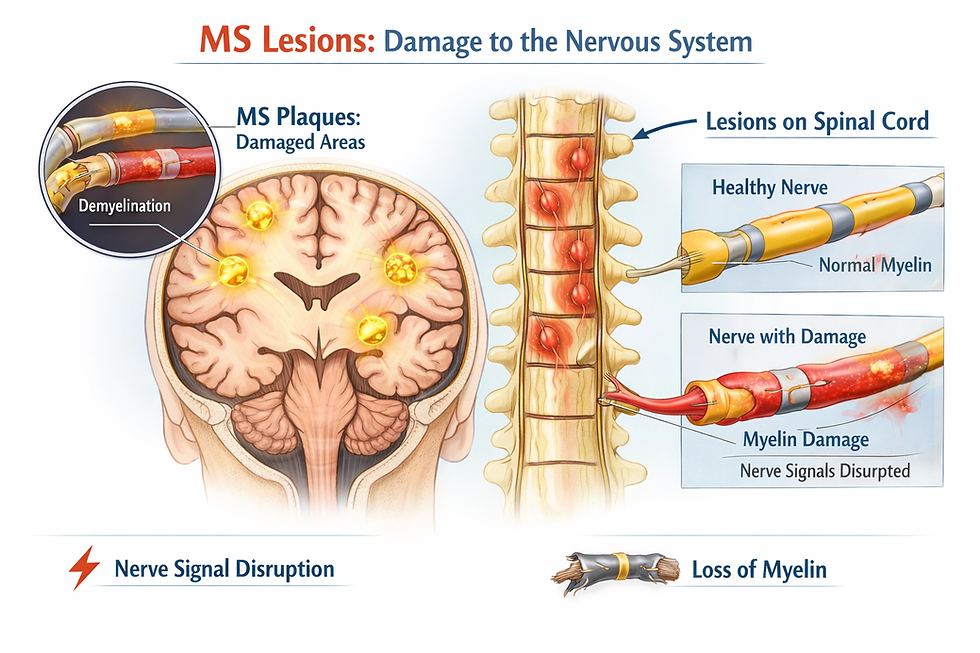
In MS, that response is directed toward the myelin sheath—the protective coating around your nerves.
And when that coating is affected?
Communication between your brain and body becomes disrupted.
Like frayed electrical wiring.
How This Shows Up: Common MS Symptoms
When nerve communication is affected, symptoms begin to appear.
You may recognize some of these:
Fatigue that doesn’t lift with rest
Pain or unusual sensations
Balance issues or “wobbliness”
Brain fog or difficulty concentrating
These symptoms are often seen as random or unpredictable.
But they’re not.
They are signals.
Your body is communicating.
Your internal alarm system is going off.
So… What Triggers the Immune System in MS?
Over the years—through both my clinical work and my own experience living with MS—I’ve seen clear patterns.
There are common factors that tend to activate or “trip” the immune system.
Let’s walk through the most important ones.
1. Gut Health and the Immune System
This is one of the most significant—and often overlooked—areas.
Your gut and your immune system are in constant communication.
When that relationship becomes strained, the immune system can become reactive.
Common contributors include:
Microbial imbalances (bacteria, yeast, or infections that keep the immune system activated)
Intestinal permeability (“leaky gut”) allowing particles into the bloodstream that shouldn’t be there
Food sensitivities often developing as a result of gut imbalance
These factors don’t happen in isolation.
They build on each other.
And when the gut is inflamed…
The immune system becomes more sensitive and reactive.
2. Environmental Triggers
We often think of toxins as something “out there.”
But many are much closer than we realize.
Common environmental triggers include:
Mould and poor air quality
Dust, carpets, and allergens
Cleaning products and synthetic fragrances
Plastics and chemical exposure
Over time, these exposures can quietly stimulate the immune system.
Not dramatically—but consistently.
Until the system becomes overloaded.
3. Viral and Infectious Triggers
Certain viruses are strongly associated with MS.
These include:
Epstein-Barr Virus (EBV)
HHV-6
Other herpes-family viruses
These infections may not fully leave the body.
Instead, they remain in the background.
And when the immune system is already under pressure…
They can act as a trigger for increased immune activity.
4. Chronic Stress and the Nervous System
This is the one that is most often underestimated.
Stress is not just emotional—it is deeply physiological.
Chronic stress can:
Disrupt immune balance
Increase inflammation
Affect sleep and recovery
Keep the body in a constant “fight or flight” state
In MS, this can lead to:
Increased fatigue
Worsened symptoms
Slower recovery
When the body stays in survival mode, healing is postponed.
This is why supporting your nervous system is not optional. It’s foundational.
The Shift That Changes Everything
Here’s what I want you to really take in:
Your symptoms are not random.
Your immune system is not failing.
Your body is responding.
And when you begin to:
Support gut health
Reduce environmental load
Address underlying triggers
Regulate your nervous system
Something important happens.
The alarm system begins to quiet.
The body recalibrates.
And healing—real, sustainable healing—becomes possible.
What This Means for You
If you’re reading this and thinking:
“This makes sense… but where do I start?”
You’re not alone.
This work is layered.
And it’s not something you’re meant to navigate in isolation.
A Place to Begin
This is exactly why I created the MS Collective.
A space where we take all of this complexity—and make it:
Practical
Understandable
Actionable
Where we:
Connect the dots
Focus on what actually matters
Apply it step by step
Support each other along the way
So you can move from confusion…
To clarity.
And begin to truly live beyond the diagnosis.
A Final Thought
You are not broken.
Your immune system is not your enemy.
And your body is not working against you.
It has been trying to guide you all along.
The question is…
Are you ready to start listening?


Comments